

HEAT EXCHANGER TUBES- SEAMLESS & WELDED
Special Metals Indonesia is a distributor of high quality seamless & welded tubing certified to SA-178 Grade A and SA-214. Specializing in boiler tubes, condenser tubes, heat exchanger tubes, ferrules, and boiler tube plugs. Our customers include mechanical contractors, original equipment manufacturers, fabricators, fertilizer plants, petro-chemical plants, Rayon mills, Paper and Pulp mills, utility power plants, Oil & Gas refineries and other distributors located throughout the South East Asia region. We highly specialize in supplying titanium Gr2 SMLS & welded tubes and special grade alloy materials. Whatsapp your requirements to us.
Titanium is mainly classified into two categories, commercially pure CP Grades, and alloys with additives such as aluminum and vanadium. We are a titanium tubing supplier, and our inventories consist of both types and cover both seamless and welded methods of manufacture.
Titanium Tubes for Pressure Vessel Applications:
Titanium tubes are critical in pressure vessel applications across industries where the combination of high pressure and aggressive chemical environments would cause standard alloys to fail.
The following industries rely on titanium tubes for their pressure-critical systems:
1. Chemical & Petrochemical Processing
This is the primary consumer of titanium pressure vessels. The metal’s immunity to chloride-induced stress corrosion makes it the industry standard.
-
Purified Terephthalic Acid (PTA): High-pressure reactors and distillation columns used to produce PTA (for polyester) operate in hot acetic acid environments where only titanium survives.
-
Urea & Fertilizer Production: Titanium tubes are used in the high-pressure strippers and condensers of urea plants to handle carbamate solutions.
-
Acid Processing: Vessels handling oxidizing acids like nitric acid or chromic acid utilize titanium for long-term structural integrity.
2. Oil & Gas (Offshore and Subsea)
As extraction moves to “sour” wells and deeper waters, pressure vessel requirements become more extreme.
-
Subsea Umbilicals: High-pressure titanium tubes house the control lines that run from the surface to the seabed, resisting both internal pressure and external seawater corrosion.
-
Chemical Injection Units: These systems pump corrosion inhibitors into wells at high pressures; titanium prevents the injection lines from corroding from the inside out.
-
Drilling Risers: Large-diameter titanium tubes are used as high-pressure conduits between the wellhead and the offshore platform.
3. Power Generation
-
Nuclear Power: Titanium tubes are used in the high-pressure condensers and heat exchangers of nuclear reactors. In some designs, titanium is used for the containment of nuclear waste in deep-sea or high-pressure underground storage.
-
Geothermal Energy: Titanium pressure vessels handle the “brine” extracted from deep underground, which is often a high-pressure, high-temperature mixture of salts and corrosive gases.
4. Mining & Hydrometallurgy
-
High-Pressure Acid Leaching (HPAL): In the extraction of nickel, cobalt, and gold, ore is processed in massive pressure vessels called autoclaves. Titanium tubes and linings are used inside these autoclaves to withstand the combination of sulfuric acid and pressures exceeding 4,000 kPa (600 psi).
5. Desalination
-
Brine Heaters: In Multi-Stage Flash (MSF) desalination plants, titanium tubes are used in the high-pressure heating stages where seawater is boiled under pressure.
-
Reverse Osmosis (RO): High-pressure pump components and membrane housings in large-scale RO plants often utilize titanium to prevent pitting from high-velocity brine.
Comparison of Pressure Vessel Construction Methods
Industries choose the construction method based on the pressure rating and the total volume of the vessel:
| Method | Industry Preference | Engineering Reason |
| Solid Titanium | Pharma, Food, Small Reactors | High purity; lighter weight for smaller units. |
| Explosion Clad | Mining, Petrochemical | Cost-effective for large diameters; uses steel for strength and Ti for corrosion. |
| Loose Lining | Low-Pressure Storage | Lowest cost; titanium “sleeve” inserted into a steel shell. |
6. Emerging & Niche Industries
-
Pharmaceutical & Biotech: Used in high-pressure fermentation tanks and reactors where metal ion contamination must be zero to protect the “batch” integrity.
-
Pulp & Paper: Specifically in the bleaching section, where titanium pressure vessels handle chlorine dioxide and other aggressive bleaching agents.
- Aerospace & Defense: High-pressure tanks for satellite propulsion systems and oxygen storage in submarines.
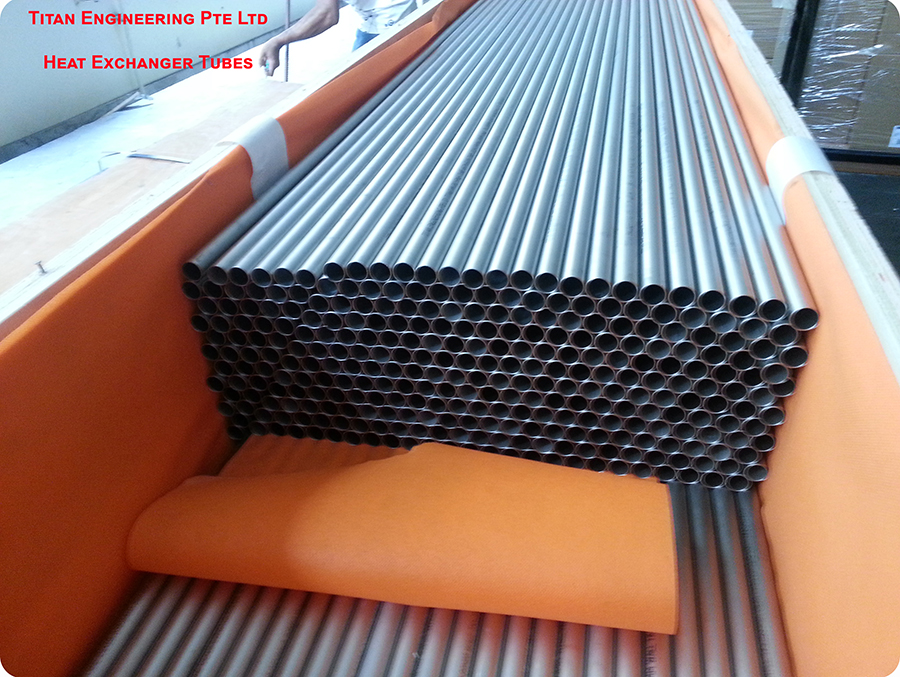
A titanium heat-exchanger or condenser is a heat-transfer equipment, made up of commercially pure titanium, that is used for transfer of internal thermal energy between two or more corrosive fluids. As stainless steel will corrode very fast when in contact with corrosive fluids or chemicals, CP titanium is used. Titanium tubes manufactured to ASME SB-338 / ASTM B338 are widely used in the fabrication of tubular heat exchangers. The tubular heat exchanger mainly covers double-pipe heat exchanger, shell and tube heat exchanger, and coiled tube heat exchanger. The titanium tubes can be furnished in either seamless or welded style.
In chemical process industries, the use of Titanium Heat Exchangers has been found to be a cost-effective method of resisting leaks from corrosion on a process line. Titanium Heat Exchangers are highly cost-effective over the entire life cycle of the equipment. Properly maintained, Titanium Heat Exchangers can operate for decades, making them a very economical choice. In 2022, we supplied titanium tubes for a titanium re-tubing project, the original titanium condenser was installed in 1980 – worked for four decades. Contact our Singapore office or our Jakarta Office.
The high resistance of titanium to corrosion prevents buildup of corrosion products which rob other metals of heat transfer efficiency. Titanium’s hard, smooth surface also minimizes buildup of external fouling films and makes cleaning and maintenance easier. The excellent resistance of titanium to turbulence and erosion-corrosion permits use of relatively high flow rates of 18-22 ft./sec. in silt-laden seawater or even up to 100 ft./sec. in clean seawater without damage to the passive oxide film.
Tests in 80°F (27°C) sea water for 60 days at 25 ft./sec. have shown titanium’s corrosion-erosion resistance to be 80 times better than that of the next-best material, a copper-nickel alloy. Other tests in 85°F (29°C) sea water for 60 days at 27 ft./sec. proved titanium to be almost 100 times better than stainless steel, the next-best material.
Putting it all together – the resulting overall heat transfer rate of titanium surfaces is often comparable to that of metals with higher thermal conductivity. The overall heat transfer coefficient of titanium in a desalination environment equalizes to that of 90-10 copper nickel after a short operating period. The copper-nickel alloy, due to its higher thermal conductivity, had a higher overall heat transfer coefficient when first placed in service with clean surfaces. However, as fouling due to corrosion product proceeded on the 90-10 alloy with time, the heat transfer coefficient dropped to a value equal to that of titanium which did not experience corrosion product fouling. Contact us for your condenser tube requirements.
My boss calls me “The computer”
Not because of my calculation skills but because I go to sleep when left unattended for 15 minutes. 🙂